
B2B Brand Building: Why 95% of Your Market Isn't Buying Yet
Most B2B marketing programmes are built to harvest. Every dollar is expected to produce a lead this quarter, every campaign is judged on cost per MQL, and anything without a form fill inside the attribution window is cut at the next budget review. That approach aims almost the entire budget at a sliver of the market, and ignores the far larger group of companies who will be buying from someone in two or three years.
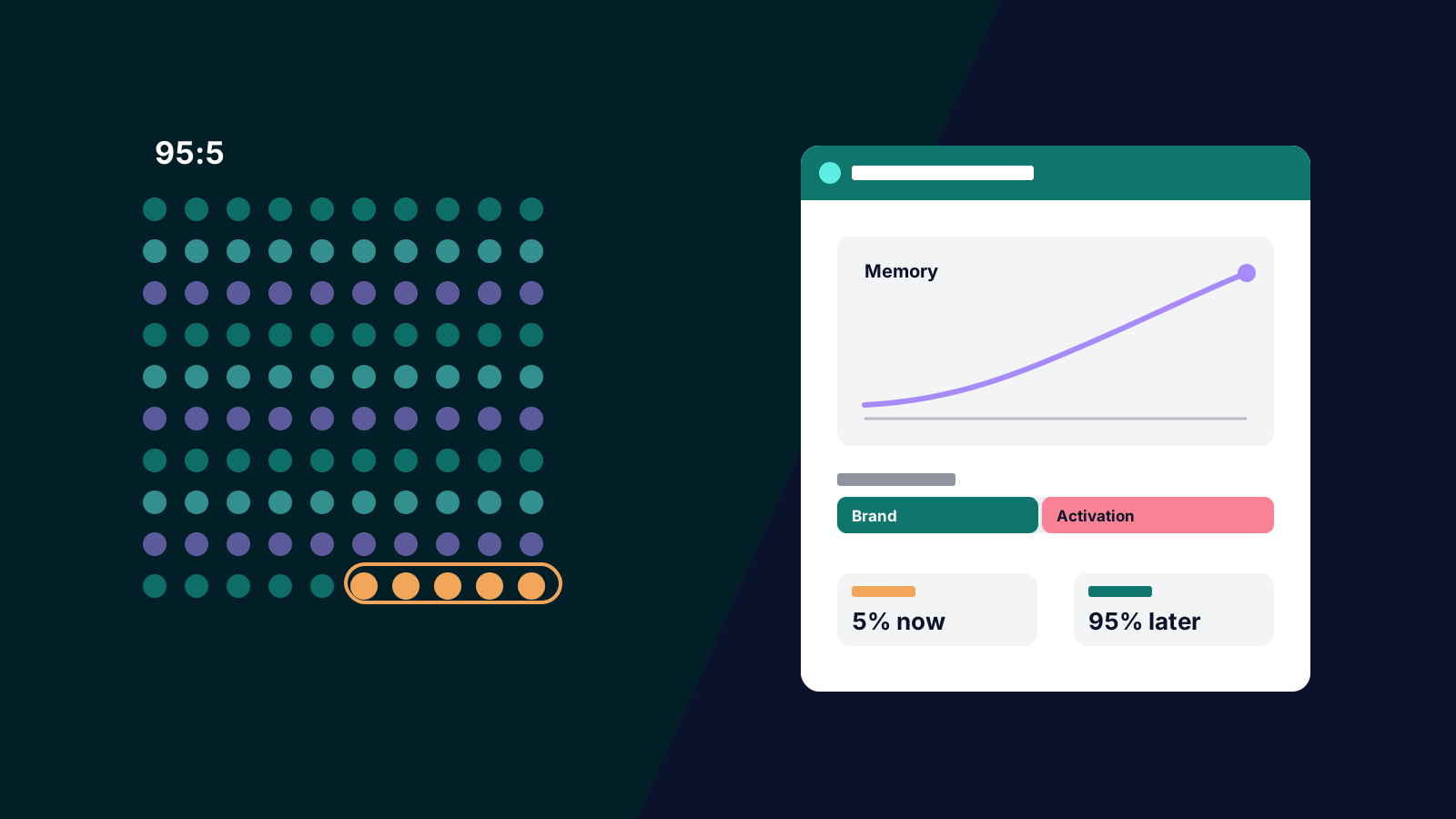
That sliver has a name. The 95:5 rule, from the Ehrenberg-Bass Institute and LinkedIn's B2B Institute, says that at any given time only around 5% of B2B buyers are in market. Here is where it comes from, what it means for spend, and how to measure brand building so finance will accept it.
Where the 95:5 Rule Comes From
The idea was set out by Professor John Dawes of the Ehrenberg-Bass Institute in a paper published by the B2B Institute in 2021. His illustration was deliberately simple: if businesses change a key supplier, such as their principal bank or law firm, roughly once every five years, then about 20% are in market in a given year, and something like 5% in a given quarter. The other 95% are not ignoring you; they are simply not buying yet.
Two caveats matter. First, 5% is an illustration built on an assumed purchase cycle, not a measured constant, so your real ratio depends on your category's cycle. Second, out of market does not mean out of reach. The B2B Institute's explainer on the 95-5 rule makes the key point: advertising does not push buyers into market, it builds the memories that decide who comes to mind when they get there.
Lead Generation Only Fishes in the 5%
A lead-gen-only programme competes ferociously for the 5% and does nothing for the 95%. Every competitor bids on the same in-market searches, intent data and retargeting pools, so the cost of winning that 5% climbs while the share you can win is capped by how well known you already are.
In our experience, B2B buyers entering market start with a shortlist assembled from memory, and the brands on it win a disproportionate share of deals. If you were not known before the trigger event, your best campaign is fighting for a place on a shortlist that is already mostly written. That is why cost per qualified lead creeps up annually in harvest-only accounts, and why fixing lead quality only takes you so far: it improves how efficiently you catch the 5%, not how many of them already know you.
Building Memory Across the Buying Group
Brand building in B2B means linking your name to the moments that trigger a purchase: the new CFO consolidating vendors, the audit finding, the contract renewal. These are category entry points, and planning reach around them gives creative something specific to say to people who are not yet looking.
The audience is wider than most B2B targeting assumes. Les Binet and Peter Field's The 5 Principles of Growth in B2B Marketing, built on IPA Databank cases for the B2B Institute, argues that media should reflect the whole buying committee and its influencers, and even people whose careers will later put them in buying roles. That is a different job from the tight account lists of account-based marketing. The channels that do it well tend to be:
- LinkedIn, bought for reach and frequency across the buying group, not just lead forms
- YouTube and online video, for memorable creative at low cost per thousand
- Events and sponsorships, where the category's buyers gather in person
- Podcasts and audio, which reach senior people in long, attentive sessions
None of this replaces LinkedIn demand generation; it gives that activity a warmer audience to convert.
Measuring What Brand Does in B2B
Brand effects in B2B are slow and diffuse, so expect movement over quarters rather than weeks. On the leading side, share of search and branded search volume are the cheapest signals that more of the market is thinking of you. On the commercial side, watch pipeline velocity, sales cycle length and win rate, because known brands get shortlisted earlier, face fewer objections and lose fewer deals on price. Track each as a trend against a pre-campaign baseline, ideally by region or segment for comparison.
Making the Case to the CFO
The B2B Institute frames brand advertising as an investment in future cash flows, which is how a CFO already thinks about capital decisions. Use that framing. Size the out-of-market pool in your addressable market, estimate how many accounts enter market each year from typical contract length, and model the AUD value of a few points more win rate across that future pipeline.
On budget, Binet and Field's analysis for LinkedIn found B2B efficiency peaked at around 46% brand and 54% activation, a more even split than the B2C benchmark in the 60/40 rule. Treat it as a direction, not a target. In our experience most B2B programmes sit far below it, so a staged shift with agreed measures and a review after two or three quarters is an easier conversation than a dramatic reallocation.
If you want help sizing your out-of-market opportunity and building a brand programme your finance team can track, our performance branding team does this for B2B businesses as standard. Get in touch.