
The 60/40 Rule Revisited: Balancing Brand and Performance Spend
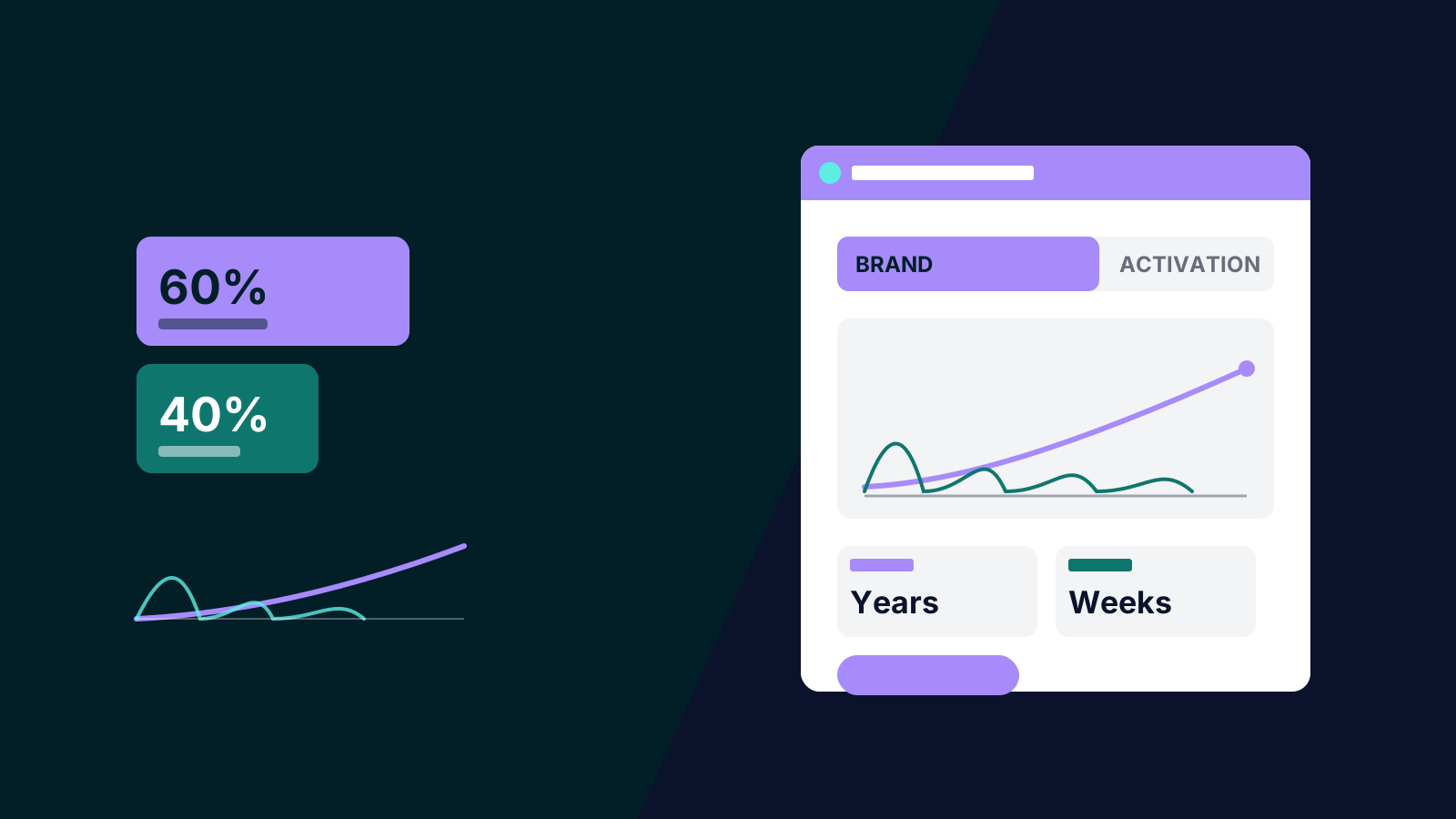
Ask a room of marketers how to split budget between brand and performance and someone will say 60/40 within the first minute. The ratio has become shorthand for an entire philosophy of marketing investment. Like most shorthand, it gets repeated far more often than it gets understood, and applying it blindly can be as costly as ignoring it.
This article goes back to what the research actually says, where the ratio genuinely applies, where it does not, and how to work out the right split for your own business rather than borrowing someone else's.
What Binet and Field Actually Found
The 60/40 figure comes from Les Binet and Peter Field's analysis of the IPA Databank, roughly a thousand campaigns entered into the IPA Effectiveness Awards over three decades, published as The Long and the Short of It. Their central finding was not the ratio itself but the distinction behind it. Sales activation produces sharp, immediate, short-lived effects that decay within weeks. Brand building produces slower effects that compound over years, and it is the dominant driver of long-term profit growth, pricing power and reduced price sensitivity.
The two work on different timescales and through different mechanisms, which means a budget optimised entirely on short-term measurable response will systematically underinvest in the thing that drives most long-term value. Across the databank, campaigns balancing roughly 60 per cent brand and 40 per cent activation delivered the strongest combined results. That is the origin of the number: an empirical average across many categories, not a derived law of marketing physics.
Later work has strengthened rather than weakened the case. Follow-up analysis showed that brand building lifts short-term sales too, meaning the choice is not purely a trade-off between now and later. A useful summary of the full argument sits in Alex Murrell's precis of the book if you want the evidence without the full read.
Why 60/40 Is Not Your Number
The averaged ratio conceals wide variation, and Binet and Field said so themselves. The optimal split moves with several factors.
- Category and purchase cycle. Considered, infrequent purchases (cars, finance, B2B services) reward memory building because buyers are out of market for years at a time. Impulse and habitual categories can justify heavier activation. Binet and Field's B2B follow-up work found the balance shifts to roughly 46/54, mildly favouring activation.
- Brand maturity. A startup with no awareness has nothing for activation to harvest, but also no revenue base to fund patience. Early-stage businesses typically run activation-heavy out of necessity, then rebalance as diminishing returns appear.
- Online versus offline revenue. Brands that transact entirely online, with strong direct response infrastructure, tend to sit somewhat below 60 per cent brand. Subscription businesses with high lifetime value sit above it.
- Competitive conditions. If competitors outspend you on brand while you harvest demand, your activation efficiency will erode year by year as their mental availability grows and yours shrinks. The ratio is partly a defensive question.
Treat 60/40 as the centre of a range that runs from roughly 40/60 to 80/20 depending on these factors, not as a target to hit.
The Practical Problem: Performance Is Measurable, Brand Is Not (Yet)
The reason budgets drift toward activation is not that anyone disputes the research. It is that activation produces a ROAS figure every week and brand produces a leap of faith. When budgets tighten, the line item without a number attached gets cut, a dynamic we covered in our piece on what performance branding is.
The correction is not to exempt brand spend from scrutiny. It is to measure it properly on its own timescale. Share of search provides a free leading indicator of whether brand investment is registering. Brand lift studies test whether campaigns shift awareness and consideration. And media mix modelling quantifies the sales contribution of brand channels that attribution tools cannot see. With those in place, the brand line survives budget reviews on evidence rather than faith.
Finding Your Own Split
A workable process looks like this. Start from your current effective split, which is usually further from 60/40 than anyone realises once you classify honestly: most "brand" campaigns judged on last-click ROAS are activation wearing brand's clothes. Classify by objective and measurement, not by channel. YouTube bought against reach and measured by lift is brand; YouTube bought against conversions is activation.
Then move incrementally. Shift five to ten points of budget per quarter toward the underweighted side and watch the indicators that operate on the relevant timescale: activation metrics within weeks, share of search within months, modelled contribution within quarters. Diminishing returns on activation spend, rising acquisition costs, and heavy dependence on discounting are the classic symptoms of underinvested brand. Falling conversion rates on healthy traffic suggest the opposite imbalance.
Finally, accept that the answer moves. Review the split annually against margin trends, category growth and competitive spend, not against a ratio published in 2013.
The 60/40 rule earned its influence because the underlying finding is robust: businesses that fund memory as well as harvest demand grow more profitably over any horizon longer than a quarter. The number itself was never the point. If you want help finding your balance and building the measurement to defend it, our performance branding team does exactly this work. Get in touch.