
Meta Conversions API: Why Pixel-Only Tracking Undersells Your Results
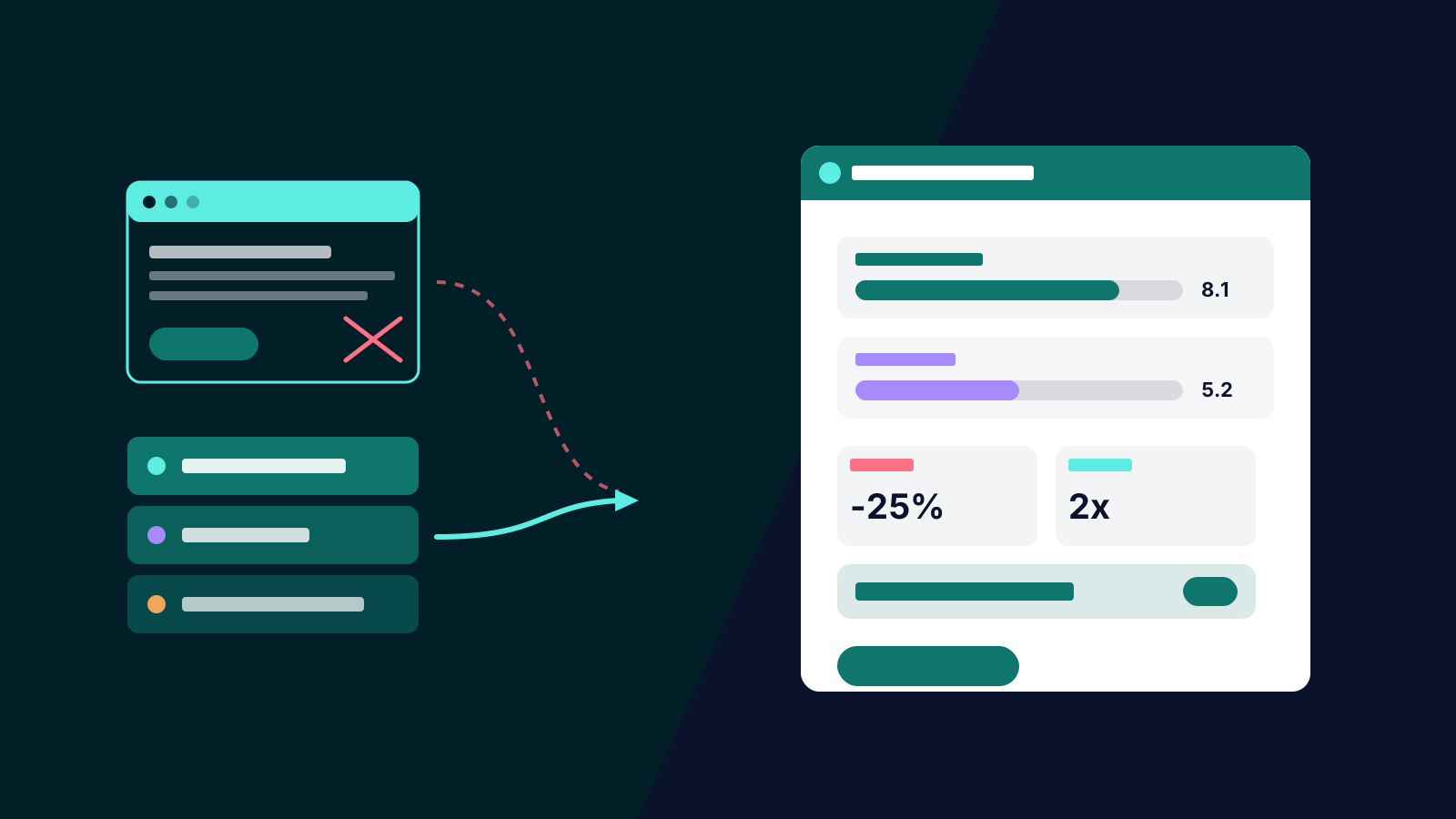
If your Meta account still measures conversions through the pixel alone, two things are quietly true. Your reported results understate what the campaigns actually drive, and — the part that costs real money — the delivery algorithm is optimising on incomplete information. Meta's systems learn from the conversion events they receive; every lost event is a lesson the algorithm never gets. Signal loss is not a reporting inconvenience. It degrades the optimisation itself.
The fix has existed for years and most advertisers have still not implemented it properly. This article covers what the Conversions API does, why implementation quality — not implementation alone — determines the benefit, and the practical routes to getting it live.
Where the Pixel Loses Signal
The pixel is JavaScript running in a browser, and browsers have spent a decade turning against it. Safari's Intelligent Tracking Prevention caps the lifetime of the cookies the pixel relies on, so returning visitors on Apple devices frequently arrive as strangers. Ad blockers and privacy extensions block the pixel script outright for a meaningful slice of users. Consent banners suppress it for everyone who declines. Slow pages lose events when users navigate away before the script fires. And iOS App Tracking Transparency removed a large share of device-level signal across the ecosystem.
Each mechanism trims a percentage. Compounded, it is common to find accounts where a quarter or more of real conversions never reach Meta. The campaigns are performing better than reported — but they are also being optimised worse than they could be, because bidding, audience selection and budget allocation all run on the surviving fraction.
What the Conversions API Does
The Conversions API sends conversion events to Meta from your server rather than the user's browser. Server-side events are immune to ad blockers, script failures and browser cookie restrictions, because there is no script and no browser cookie involved in transmission. The pattern is the same one we described for server-side tagging with Google Tag Manager: move measurement from the least reliable environment on the internet to one you control.
CAPI is not a pixel replacement — it is a redundant channel. Best practice sends every event both ways, browser and server, with a shared event ID so Meta deduplicates the pairs. The pixel catches what it can; the server fills the gaps; nothing counts twice. Deduplication is where sloppy implementations go wrong, and an account double-counting purchases is worse off than one under-counting them, so this detail deserves care rather than confidence.
Consent obligations do not disappear server-side. A user who declines tracking must be excluded from server events just as from browser events — CAPI restores signal lost to technical failure, not signal you are not permitted to collect.
Event Match Quality Decides What You Get Back
Receiving an event is only half the job; Meta must match it to an account before it can inform attribution or optimisation. Matching runs on the customer information sent with each event — hashed email, phone number, name, click ID, IP address — and Meta scores how well you are doing per event as Event Match Quality, a 0–10 rating visible in Events Manager.
EMQ is the single best predictor of whether your CAPI implementation was worth doing. A server event with no identifiers matches nothing and might as well not exist; the same event carrying a hashed email and click ID matches most of the time. Hashed email and phone are the strongest signals, and adding parameters systematically is usually the cheapest performance improvement available after go-live. For purchase events, treat a score in the high single digits as the standard; below the mid-range, significant volume is arriving unusable. Larger operations can monitor this programmatically through Meta's Dataset Quality API.
This is also why CAPI rewards businesses that have invested in first-party data foundations: the more customer identifiers your systems can legitimately attach to a conversion, the more of your signal survives the journey.
Implementation Routes
There are three practical paths, in ascending order of effort and control.
- Platform-native integrations. Shopify, WooCommerce and the major ecommerce platforms offer built-in or one-click CAPI connections. Adequate for standard purchase funnels; limited when you need custom events or server-side enrichment.
- Server-side Google Tag Manager. A server GTM container receives events once and fans them out to Meta, Google and any other endpoint. More setup, but it solves signal quality for every platform simultaneously rather than once per vendor — usually the right answer for businesses already invested in GTM. This is the architecture we deploy in most server-side tracking engagements.
- Direct integration. Your backend calls the API directly. Maximum control, appropriate when conversions live in a CRM or subscription system rather than a website — and the only route that cleanly supports sending qualified-lead or repeat-purchase events upstream.
Whichever route: implement deduplication first, verify it in Events Manager's overlap view, then work EMQ upward parameter by parameter.
What to Expect Afterwards
Expect reported conversions to rise — typically by double-digit percentages — without any change in actual performance. Recalibrate targets accordingly rather than celebrating a phantom improvement. The real gains arrive over the following weeks as the delivery system learns from fuller data: more stable cost per acquisition, better exclusion of existing converters, and audiences built on complete rather than partial signals.
Signal quality is unglamorous infrastructure, but on Meta it is the difference between an algorithm working with most of the truth and one working with a fraction of it. If you want your implementation done properly — or audited, because many "completed" CAPI setups fail on deduplication or EMQ — our paid social team handles both. Get in touch.