
When to Bring Performance Marketing In-House (and When Not To)
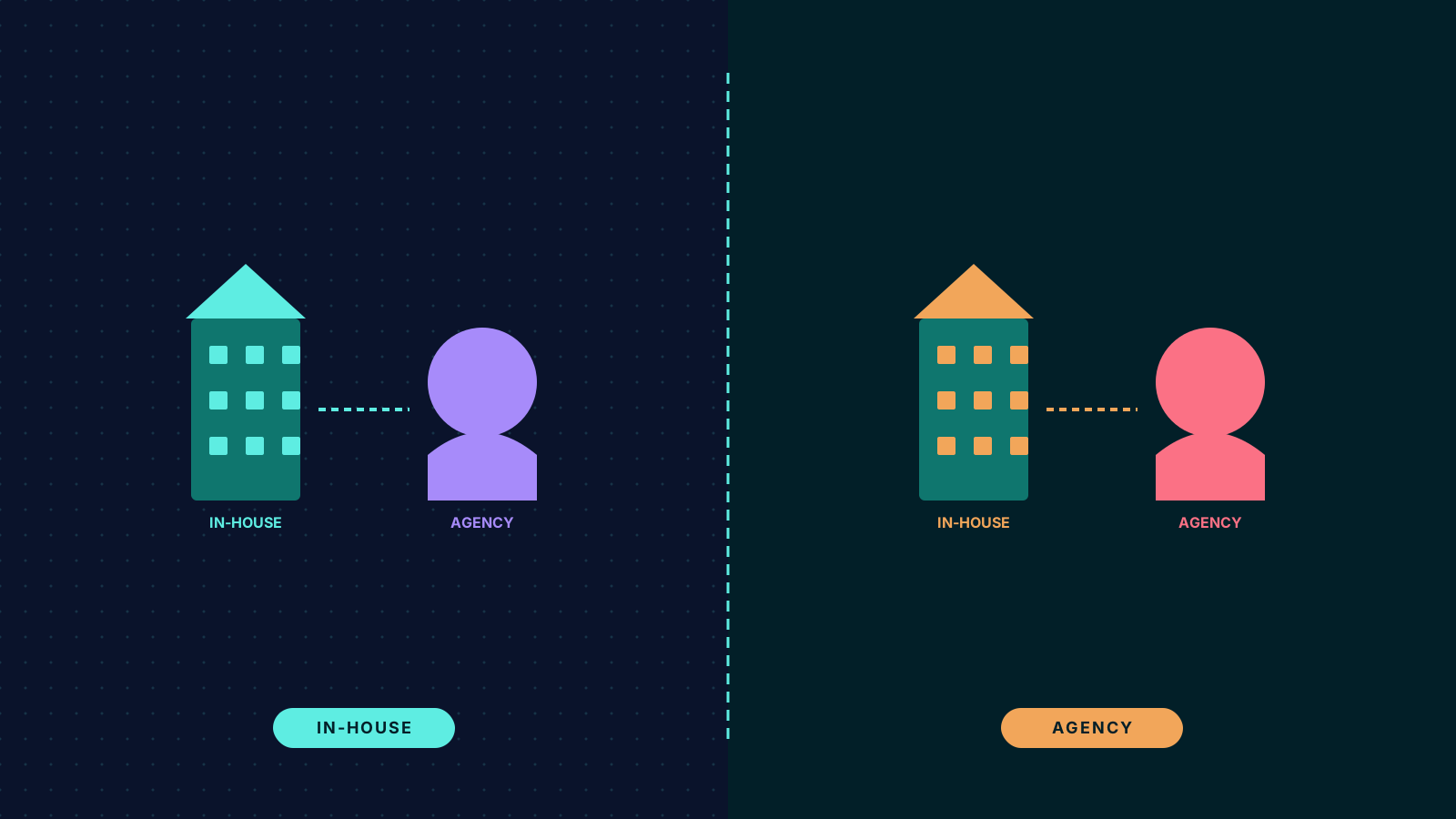
The question of whether to manage performance marketing in-house or through an agency comes up in every growing business. There is no universally right answer. The decision depends on your team's capability, your technology stack, your spend level, and what you actually need from performance marketing management.
The in-housing trend has been building for years, driven by a desire for greater control, faster execution, and reduced agency fees. But the businesses that have done it successfully look very different from those that tried and reverted. Understanding what separates the two is the key to making the right call for your organisation.
Here is a practical framework for evaluating the decision based on where your business actually stands, not where you hope it will be.
The Case for In-House Management
In-house performance marketing works best when three conditions are met: you have the right people, you have the right infrastructure, and your spend level justifies the investment in both.
The talent requirement is the most critical and most underestimated factor. Effective paid search and paid social management requires deep platform expertise that takes years to develop. It is not enough to hire someone who can navigate the Google Ads interface. You need people who understand auction dynamics, bidding algorithms, attribution models, and how to interpret performance data in context.
You also need depth. A single performance marketer managing all paid channels is a single point of failure. When that person takes leave, changes roles, or leaves the company, your campaigns are unmanaged. Agencies provide built-in redundancy and knowledge continuity that a small in-house team cannot match.
The infrastructure requirement is equally important. In-house teams need access to competitive intelligence tools, bid management platforms, creative testing frameworks, and analytics infrastructure that agencies already have.
The Case for Agency Partnership
Agency partnerships make sense when your business benefits from breadth of expertise, cross-client pattern recognition, and the ability to scale team capacity up or down with spend levels.
The breadth advantage is real. An agency managing dozens of accounts sees patterns that an in-house team managing a single account cannot. They know which new platform features actually work because they have tested them across multiple clients.
Agencies also provide access to platform relationships and beta programmes that are typically reserved for larger spenders.
A digital marketing audit is a useful starting point regardless of which direction you are leaning. It gives you an objective assessment of your current performance and identifies whether the gaps are in execution, strategy, or infrastructure.
Spend Thresholds That Shift the Equation
Below $100,000 per month in total paid media spend, in-housing rarely makes financial sense. The cost of a capable team, tools, and infrastructure typically exceeds the agency fees you would save.
Between $100,000 and $500,000 per month, the decision becomes more nuanced. A hybrid model, in-house execution with agency strategy and oversight, often works well in this range.
Above $500,000 per month, the financial case for in-housing strengthens significantly. However, even at this level, many businesses retain agency relationships for measurement, strategy, and specific channel expertise.
The Hybrid Model
Most businesses that successfully navigate this decision end up with some form of hybrid model. The specific configuration depends on where internal capability is strongest and where external expertise adds the most value.
A common hybrid structure has the in-house team owning day-to-day campaign management for the largest channels while the agency handles strategic planning, measurement, reporting, and emerging or specialist channels.
The key to making any hybrid work is clear ownership. Every decision should have a single owner with clear accountability.
Making the Decision
Start by honestly assessing your current capability. Can you recruit and retain the specialist talent required? Do you have the infrastructure and tools? Is your spend level sufficient to justify the fixed costs?
If the answer to any of these is no, an agency partnership is likely the better near-term option. That does not mean you cannot work toward in-housing over time.
Whatever you decide, base the decision on capability and economics rather than a philosophical preference for control or a frustration with your current agency relationship.
If you need an objective assessment of where your performance marketing stands today, a digital marketing audit provides the data you need to make this decision with confidence.