
What a Full-Service Digital Marketing Agency Actually Does
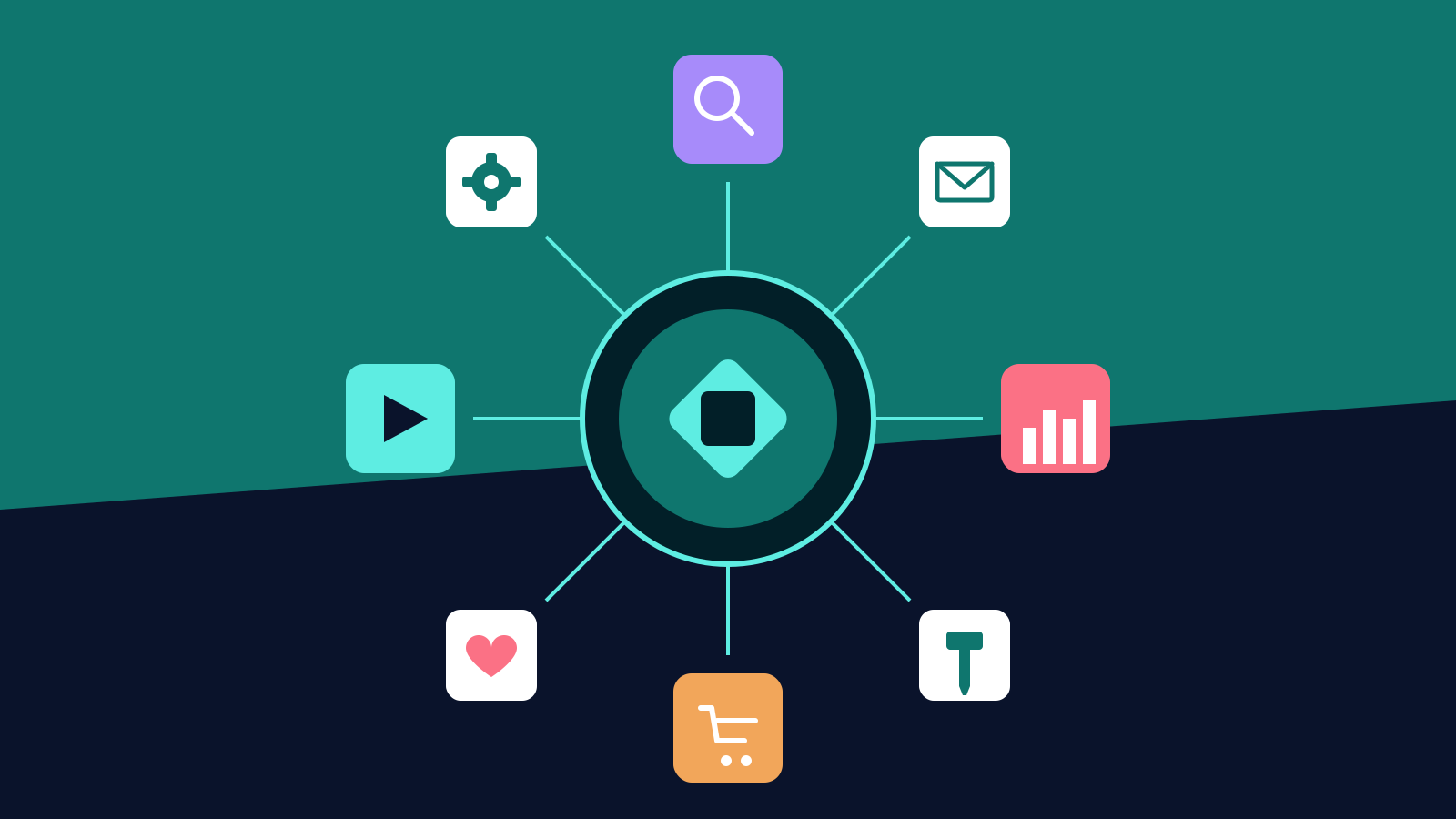
The term "full-service digital marketing agency" appears on countless agency websites across Australia, but what it actually means varies enormously. Some agencies use it to describe a team of five generalists. Others use it to describe a coordinated operation spanning dozens of specialists across every major marketing discipline.
The distinction matters because modern digital marketing is interconnected. Your paid search campaigns perform better when informed by your analytics data. Your SEO strategy should align with your paid media keywords. Your conversion rate optimisation should feed insights back into your ad creative. When these functions operate in silos, or worse, when some do not exist at all, you leave performance on the table.
Here is what a genuinely full-service digital marketing agency in Australia should offer and why each piece matters.
Paid Media: Search and Social
Paid media is often the most visible component of a digital marketing strategy. It encompasses paid search (Google Ads, Microsoft Ads) and paid social (Meta, LinkedIn, TikTok, and other platforms).
A full-service agency does not just launch campaigns and monitor spend. It builds a paid media architecture that includes audience research, keyword strategy, bid management, creative testing, landing page alignment, and ongoing optimisation. The goal is not just traffic but profitable traffic that converts.
Critically, paid search and paid social should not operate independently. Search captures existing demand while social generates new demand. A coordinated strategy ensures these channels complement rather than cannibalise each other, and that budget flows to wherever the best opportunities exist at any given time.
Search Engine Optimisation and Answer Engine Optimisation
SEO has evolved significantly. It is no longer just about ranking for keywords on Google. With the rise of AI-powered search experiences, answer engine optimisation (AEO) has become equally important. AEO focuses on structuring your content so that AI assistants and featured snippets surface your brand as a trusted authority.
A full-service agency approaches organic search holistically: technical SEO (site speed, crawlability, structured data), content strategy (topic clusters, search intent mapping), and authority building (digital PR, thought leadership). The best agencies also monitor how AI search tools reference your brand and optimise accordingly.
This is one area where the full-service model pays dividends. SEO insights inform paid media keyword strategy. Content created for SEO serves double duty in email marketing and social. Technical SEO improvements boost conversion rates by improving site performance.
Analytics and Measurement
Without robust analytics, every other service operates partially blind. A full-service agency builds the measurement infrastructure that connects marketing activity to business outcomes.
This includes proper GA4 configuration, conversion tracking, attribution modelling, and custom dashboards that show what matters. More advanced agencies also implement marketing mix modelling and incrementality testing to answer the harder questions: not just what happened, but what caused it.
The measurement function should be the connective tissue of the entire operation. It tells the paid media team which campaigns are truly driving value. It shows the SEO team which content generates qualified leads, not just traffic. It reveals where the funnel leaks and where investment should increase.
Conversion Rate Optimisation
Conversion rate optimisation (CRO) is the practice of systematically improving the percentage of website visitors who take a desired action. It sits at the intersection of data analysis, user experience design, and behavioural psychology.
A genuine CRO practice involves quantitative analysis (heatmaps, session recordings, funnel analysis), qualitative research (user surveys, usability testing), hypothesis formation, A/B testing, and iterative improvement. It is not just changing button colours.
CRO is one of the highest-leverage activities in digital marketing because it multiplies the value of every other channel. If you double your conversion rate, you have effectively doubled the return on every dollar spent driving traffic to your site.
Lifecycle Marketing and Automation
Acquiring a customer is only half the equation. Lifecycle marketing focuses on what happens after the first conversion: onboarding, engagement, retention, upselling, and reactivation.
A full-service agency builds automated email and messaging sequences that nurture leads through the sales funnel and keep existing customers engaged. This includes welcome series, abandoned cart recovery, post-purchase follow-ups, re-engagement campaigns, and loyalty programmes.
The integration with marketing automation and AI has made lifecycle marketing significantly more sophisticated. Modern tools enable personalisation at scale, predictive send-time optimisation, and dynamic content that adapts to individual customer behaviour.
Demand Generation and Performance Branding
Demand generation is the strategic function that sits above individual channels. It orchestrates the full journey from awareness to revenue, ensuring that top-of-funnel activity translates into bottom-line results.
Performance branding bridges the traditional gap between brand marketing and performance marketing. Rather than treating these as separate disciplines with separate budgets and separate goals, a full-service agency integrates them. Brand activity is measured by its contribution to performance. Performance activity is designed to build brand equity.
This integrated approach is increasingly important as acquisition costs rise across all digital channels. Businesses with strong brands pay less per click, convert at higher rates, and retain customers longer.
Why Integration Matters More Than Individual Services
The real value of a full-service digital marketing agency is not the breadth of services listed on its website. It is the integration between those services.
When your analytics team discovers that a particular audience segment converts at three times the average rate, that insight should immediately flow to your paid media team for targeting, your SEO team for content creation, and your lifecycle marketing team for personalised nurture sequences.
When your CRO team learns that a specific value proposition resonates strongly in A/B tests, that language should appear in your ads, your email subject lines, and your organic search snippets.
This kind of cross-functional intelligence sharing is nearly impossible when services are fragmented across multiple specialist agencies. It is the core advantage of the full-service model and the reason it delivers compounding returns over time.
If you are evaluating agencies and want to understand how an integrated approach could work for your business, reach out for a conversation about your marketing goals.