
Why UGC Is Beating Studio Creative on Meta in 2026
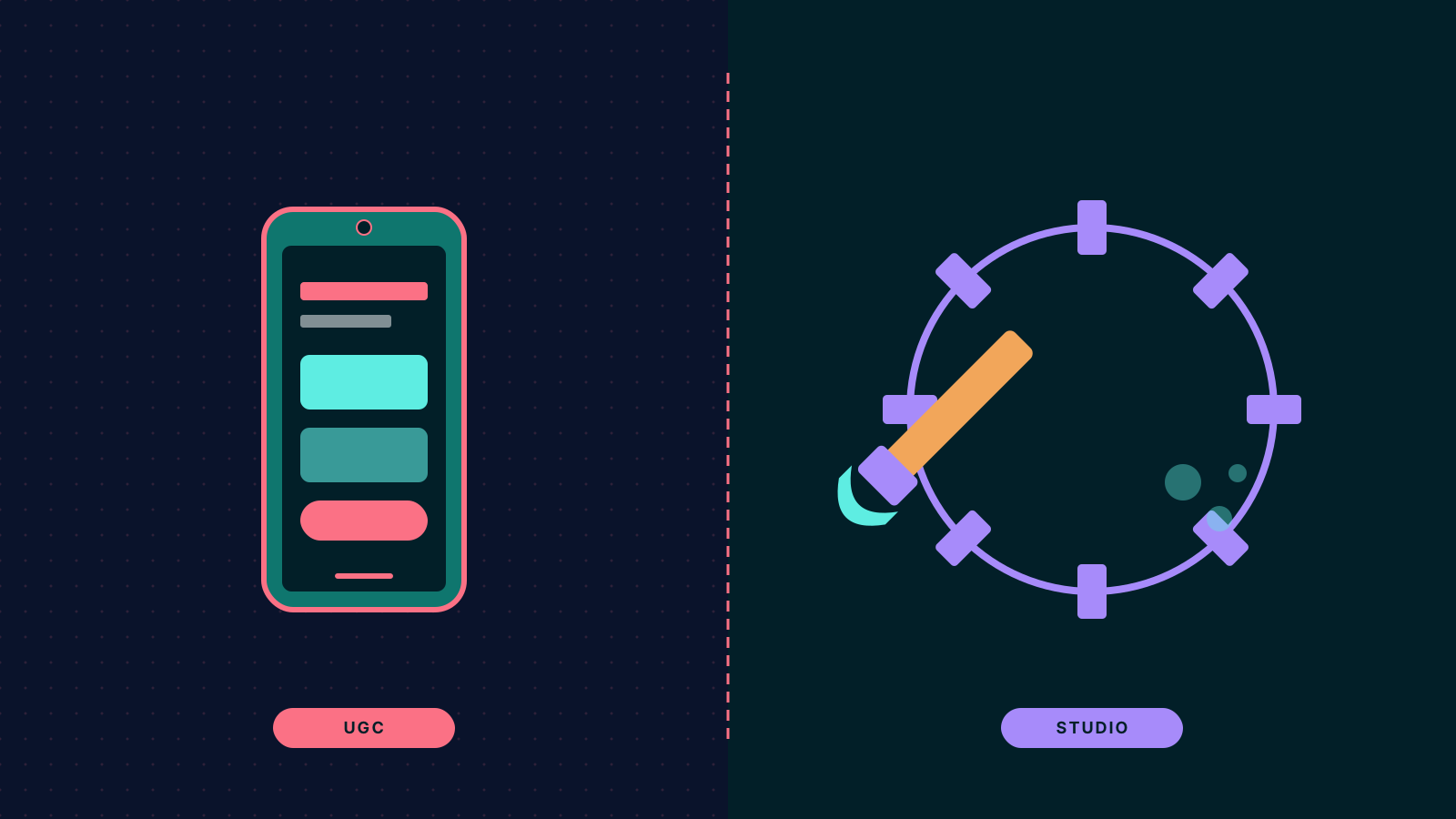
User-generated content is not an emerging trend on Meta. It is now the dominant format for direct-response advertising, consistently outperforming polished studio creative across every major performance metric. The data is unambiguous: UGC converts 2.8 times better than traditional studio ads and generates 4.2 times higher engagement rates. Yet many marketing teams continue to invest heavily in high-production-value content despite diminishing returns. Understanding why this shift has happened, and when studio creative still matters, is essential to building efficient acquisition campaigns in 2026.
The Scale of the Shift
The performance gap between UGC and studio creative has widened dramatically over the past two years. Brands testing both formats report consistent findings across industries: UGC outperforms studio creative by 2-4x on Meta platforms. This is not marginal improvement. This represents a fundamental change in what the Meta algorithm rewards and what users engage with.
The numbers are striking. UGC content achieves 4.2 times higher engagement rates compared to studio-produced ads. When filtered to conversion metrics that matter for ROI, UGC delivers 2.8 times better conversion rates. These are not outliers. They reflect patterns observed across hundreds of accounts running A/B tests throughout 2025 and into 2026.
The shift transcends product categories. Ecommerce brands, SaaS companies, financial services, and consumer goods all report similar findings. The format works across demographics. The performance advantage is real and measurable.
Why the Algorithm Favours Authenticity
The mechanism driving this shift lies in how Meta's recommendation algorithm operates. The platform's core incentive structure rewards content that users find worth engaging with, which means content that does not immediately signal "advertisement" to the viewer.
Polished studio creative triggers an instant recognition response. High production value, perfectly lit product shots, professionally styled models, and slick editing all communicate a single message to the user: this is a paid advertisement. The user's brain categorises the content as an outbound marketing message and applies different decision-making logic than it would to organic content.
UGC operates differently. Shaky phone footage, natural lighting, imperfect takes, and genuine product integration into real-life contexts read as native to the feed. Users encounter UGC with the same mental framework they apply to a friend's post or an influencer's organic content. The content passes the authenticity test. The user is more likely to stop scrolling, watch to completion, and engage.
This is the authenticity gap. It is not about whether studio creative looks expensive. It is about whether the content signals "advertisement" or "peer recommendation." Meta's algorithm increasingly penalises the former and amplifies the latter.
The Engagement Dynamics
Higher engagement rates translate directly to lower costs and better feed placement. When UGC content generates 4.2 times more engagement than studio creative, the platform rewards it with:
- Lower cost per impression through improved organic reach
- Better placement in users' feeds due to positive engagement signals
- Higher quality score multipliers in Meta's auction system
- Longer content lifespan before fatigue sets in
Studio creative, meanwhile, suffers from the reverse. Users scroll past. Engagement metrics underperform. The algorithm deprioritises the content. Cost per result climbs. The campaign efficiency deteriorates.
The engagement advantage compounds over time. A single piece of UGC that resonates can generate months of profitable performance. Studio creative, by contrast, tends toward rapid fatigue cycles. Creative refresh becomes necessary within weeks rather than months.
The Conversion Reality
Engagement metrics matter because they correlate with conversion performance. The 2.8x conversion advantage UGC holds over studio creative reflects several factors working in concert.
First, UGC inherently positions the product within a real-world context. Viewers see how a product is used, what problems it solves, and what the experience is actually like. This reduces friction in the decision-making process. There is less gap between the advertised promise and the reality the customer will experience.
Second, UGC often includes subtle social proof. Seeing another person use and recommend a product is more persuasive than watching a professional model in a produced scenario. The viewer can project themselves onto the user in the content more easily than they can project onto a professional actor.
Third, the tone and delivery of UGC tends to build trust. Authenticity communicates honesty. Polished production can communicate the opposite: a brand with something to hide, or at minimum, a brand more interested in image than in substance.
None of this means the viewer consciously thinks through these factors. The persuasion operates at an intuitive level. Users simply convert more readily from UGC messaging because it does not trigger the same defensive scepticism that studio creative does.
The Production Economics
A second major advantage of UGC is cost. Producing high-quality studio creative requires investment in talent, equipment, locations, and post-production. A single shoot day can cost thousands of pounds and yield a limited volume of finished assets. Iteration is expensive.
UGC operates on inverted economics. Creators shoot dozens of takes in rapid succession. Content is produced quickly and at a fraction of traditional costs. A creator can produce five to ten usable pieces in the time a studio would produce one. The cost per asset is exponentially lower.
This economic advantage compounds when considered against fatigue cycles. Studio creative fatigues quickly. The same polished ad grows stale within two to four weeks of heavy exposure. At that point, new production is required, which triggers another expensive cycle.
UGC fatigues more slowly. The diverse, authentic nature of creator-produced content means users encounter greater variety even when coming from the same pool of creators. Performance typically remains profitable for six to twelve weeks before meaningful refresh becomes necessary. Over that extended window, the cost per result remains flat or improves.
The production economics strongly favour UGC at scale. A marketing team with budget can hire dozens of creators and keep multiple asset streams flowing. The total cost to sustain a UGC programme is typically a fraction of the cost to sustain equivalent volume and performance through studio creative.
Building a UGC Pipeline at Scale
Operating a successful UGC programme requires infrastructure that many teams have not yet built. The process involves content briefs, creator outreach, quality control, performance tracking, and permissions management. It is operationally more complex than contracting a single studio.
The foundation is a clear content brief. Creators need direction on what to communicate, what to demonstrate, and what tone to adopt. The brief should specify product angles to highlight and use cases to address, but should leave creative execution to the creator. Overly prescriptive briefs defeat the purpose of UGC: they produce content that looks produced.
Creator sourcing is the next critical step. This can involve working with established micro-influencers, recruiting from brand communities, or engaging through UGC platforms that connect brands with creators. The goal is volume and diversity. A portfolio of fifteen to thirty creators producing regular content provides sufficient variation to identify high performers and sustain steady output.
Quality control is non-negotiable. Not all UGC performs equally. Some creators produce generic content that lacks conviction. Others deliver work that resonates. Quality control involves reviewing submissions, requesting revisions when necessary, and identifying top performers for priority focus and increased volumes.
Rights and permissions require clear contractual frameworks. Creators must grant rights to use their content across paid channels. Pricing models vary: flat fees, performance bonuses, or ongoing retainer arrangements. Clear terms prevent disputes and ensure creators remain engaged.
Performance tracking closes the loop. Which creators produce the highest-converting content? Which content angles drive the best results? Sustained tracking identifies patterns and informs brief refinement and creator prioritisation.
When Studio Creative Still Wins
The superiority of UGC for direct response is clear. This does not mean studio creative is obsolete. Several contexts still favour polished production.
Brand awareness campaigns operate under different optimisation criteria than conversion campaigns. The goal is reach and recall, not immediate response. Studio creative, because it is memorable and distinct, often performs better for awareness objectives. A beautiful, distinctive creative treatment can embed a brand message in memory more effectively than authentic-looking UGC.
Premium positioning and luxury categories present a second context. Brands positioned in the premium segment often cannot afford to appear as casual or discount-focused as raw UGC sometimes communicates. Polished production reinforces positioning.
Product launches are a third scenario. When introducing a new product, studio creative that showcases features, benefits, and design in controlled environments may outperform UGC that lacks context for understanding what is being launched.
These exceptions are real, but they are exceptions. For the majority of performance marketing work in 2026, UGC delivers superior results.
The Spectrum Between Pure UGC and Pure Studio
In practice, the choice is not binary. Many high-performing campaigns sit between pure UGC and pure studio creative.
Lo-fi branded content occupies this middle ground. It applies production standards enough to ensure visual consistency and clarity, but maintains the aesthetic and feel of authentic user content. The lighting is natural rather than studio-lit. The location is realistic rather than designed. The talent looks like real people rather than professional models. The pacing feels natural rather than accelerated.
This middle ground often performs nearly as well as pure UGC while providing greater brand control. The content still reads as native to the feed. It avoids the authenticity gap. But it ensures messaging clarity and visual consistency across multiple pieces.
Many teams moving into UGC-heavy portfolios start with lo-fi branded content whilst building the infrastructure to manage pure UGC. This approach reduces risk whilst capturing most of the performance benefits.
Creative Fatigue and Refresh Cycles
One underestimated advantage of UGC is the shape of the fatigue curve. Studio creative tends to exhibit sharp performance cliffs. The same ad performs well for three weeks, then drops off dramatically. The cost per result doubles or triples within days.
UGC fatigues more gradually. Individual pieces fatigue, but the portfolio of content remains fresher longer. A user scrolling through feed may encounter five different pieces of UGC in a week; each piece is different enough to hold attention. A user exposed to the same studio creative multiple times recognises it immediately and scrolls past.
This difference in fatigue dynamics has cascading implications for campaign management. UGC campaigns require less frequent creative refresh. The window for profitable performance extends longer. The overall cost to sustain campaign performance is lower.
The fatigue advantage also reduces creative production pressure. Instead of needing breakthrough creative concepts every three to four weeks, a team managing UGC can sustain performance with consistent quality execution across a broader content portfolio.
Building the Case for Portfolio Rebalancing
For many teams, the data makes a clear case for rebalancing away from pure studio creative toward a UGC-dominant portfolio. The performance gap is substantial, the economics are favourable, and the operational complexity is manageable with proper infrastructure.
The process typically begins with testing. Run UGC against existing studio creative in controlled A/B tests. Measure engagement, conversion rates, and cost per result. The data will confirm what the broader market is reporting: UGC outperforms on nearly every metric.
From testing, teams can gradually shift budget allocation. This is not an overnight transition. Studio creative remains useful for specific objectives. But the allocation typically moves from studio-dominant portfolios toward UGC-heavy portfolios where perhaps seventy to eighty percent of spend flows to UGC and the remainder supports brand awareness, launches, or premium positioning work.
The transition requires investment in infrastructure: creator relationships, content management systems, permissions tracking, and performance analysis. But the return on that investment is substantial. Lower cost per result, reduced fatigue cycles, improved capital efficiency, and faster scaling are standard outcomes.
The Structural Shift Ahead
The shift toward UGC is not a cyclical trend that will reverse when studio creative becomes unfashionable. It is driven by fundamental changes in how Meta's algorithm operates and how users engage with content in their feeds. As long as the platform prioritises engagement and maintains the current recommendation infrastructure, UGC will continue to outperform studio creative.
Teams that recognise this shift and build UGC programmes in 2026 will gain competitive advantage. Teams that continue allocating the majority of creative spend to studio production will find their cost per result climbing and their competitive position weakening.
The data is clear. The direction is clear. The economics are favourable. The case for rebalancing creative investment toward UGC is among the strongest in digital marketing right now. For teams looking to maximise performance, building a full-funnel Meta ads strategy that prioritises authentic content is the logical next step. Working with an experienced paid social team can accelerate the transition and ensure the infrastructure is built correctly from the start.