
Predictive Audiences: Targeting Customers Before They Convert
Most digital advertising still operates on a reactive model. A customer visits your site, browses a product page, and then you chase them around the internet with retargeting ads. It works, but it is inefficient, expensive, and increasingly constrained by privacy regulations that limit third-party tracking.
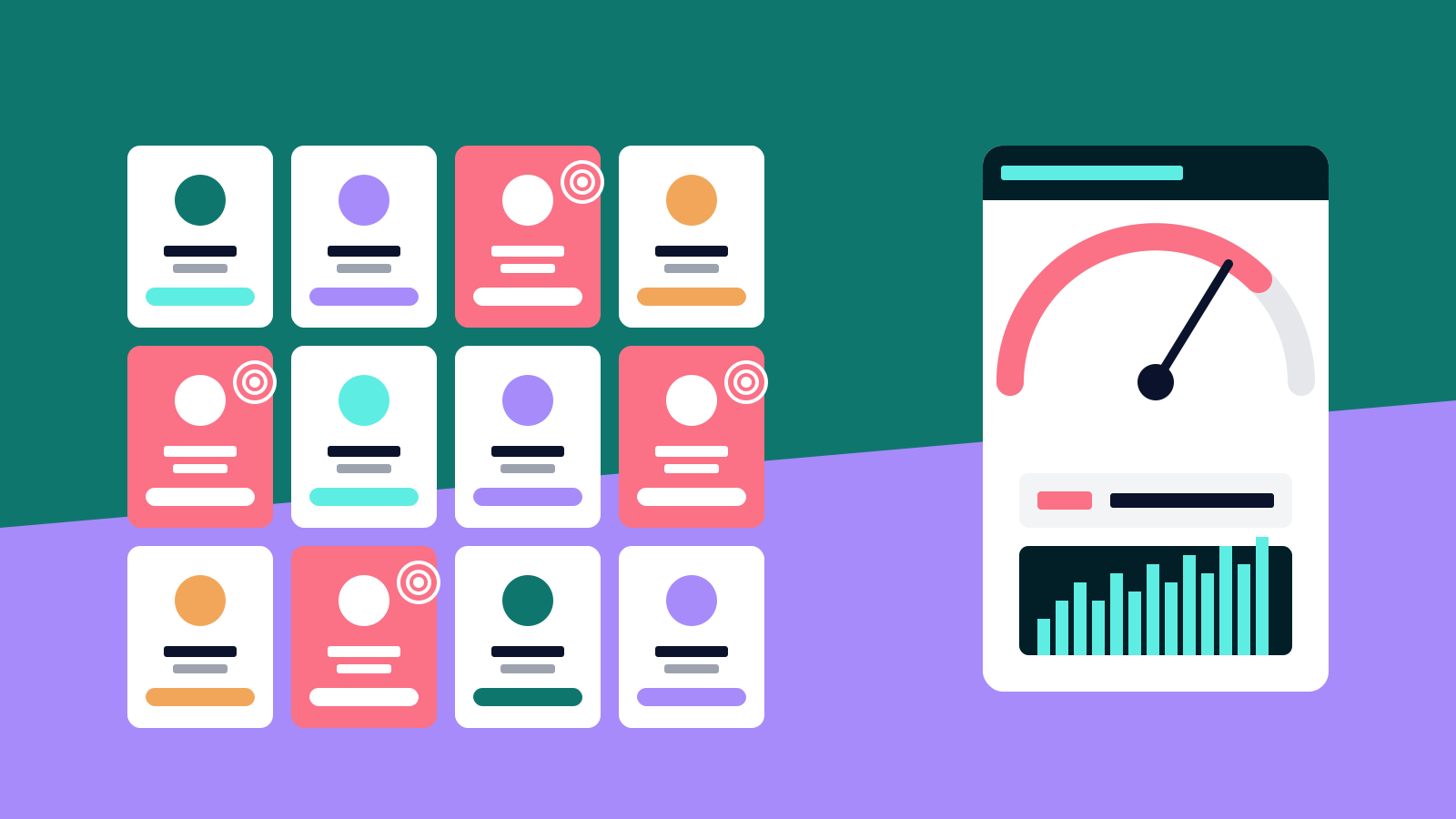
Predictive audiences marketing flips this model on its head. Instead of waiting for customers to signal intent through observable actions, you use data, machine learning, and propensity modelling to identify and reach people who are likely to convert, often before they have even visited your website. The result is lower cost per acquisition, better return on ad spend, and a paid media strategy that scales beyond the limits of your retargeting pools.
At Marketing Systems, we have seen predictive audience strategies reduce cost per acquisition by 20 to 40 percent for clients across e-commerce, SaaS, and professional services. In this article, we will walk through how predictive audiences work, why they matter now more than ever, and how you can start building them into your paid search and paid social campaigns.
The Problem with Reactive Targeting
Traditional audience targeting in paid media relies on two broad approaches: demographic or interest-based targeting (broad but imprecise) and retargeting (precise but limited in scale). Both have significant drawbacks in 2026.
Interest-based targeting casts a wide net. You select audiences based on age, location, job title, or inferred interests, and hope that your creative and offer resonate with enough people to justify the spend. Conversion rates tend to be low, and you pay for a large volume of impressions that never had a realistic chance of converting.
Retargeting, on the other hand, is inherently limited by the size of your existing audience pool. You can only retarget people who have already interacted with your brand, which means you are competing for the same shrinking pool of known visitors. With the deprecation of third-party cookies and tightening privacy controls on iOS and Android, retargeting pools are smaller and less accurate than they were even two years ago.
The gap between these two approaches is where predictive audiences live. They combine the precision of behavioural targeting with the scale of prospecting, allowing you to reach new customers who look and behave like your best converters, without relying on third-party tracking infrastructure.
What Are Predictive Audiences?
A predictive audience is a segment of users identified by a statistical or machine learning model as having a high probability of completing a desired action, such as making a purchase, submitting a lead form, or subscribing to a service. These models analyse historical conversion data alongside behavioural, demographic, and contextual signals to score each user's likelihood of converting.
The concept is not new. Propensity modelling has been used in direct mail and CRM marketing for decades. What has changed is the accessibility of the tools, the volume of first-party data available, and the native integration of predictive capabilities into the major advertising platforms.
Propensity Models Explained
At their core, propensity models are classification algorithms. They take a set of input features (data points about a user) and output a probability score between 0 and 1, representing the likelihood that the user will take a specific action.
For example, a propensity-to-purchase model might use features such as: number of site visits in the last 30 days, pages viewed per session, time spent on pricing or product pages, email engagement (opens, clicks), previous purchase history, device type and browsing context, and geographic or firmographic data.
The model is trained on historical data where the outcome is known (customers who did convert versus those who did not), and it learns which combinations of features are most predictive of conversion. Once trained, it can score new users in real time or in batch, allowing you to build audience segments based on predicted behaviour rather than observed behaviour alone.
First-Party Data: The Foundation of Predictive Audiences
Predictive audiences are only as good as the data that feeds them. In a privacy-first landscape, first-party data is the most valuable, reliable, and compliant data source you have. This includes CRM records, website analytics, app usage data, email engagement, purchase history, and customer support interactions.
The organisations that benefit most from predictive audiences marketing are those that have invested in collecting, unifying, and activating their first-party data. If your customer data lives in disconnected silos, with your CRM in one system, your web analytics in another, and your ad platform data in a third, you will struggle to build the rich user profiles that propensity models require.
This is why we recommend that clients begin with a solid analytics foundation before layering on predictive capabilities. A well-structured data layer, proper event tracking, and a customer data platform (CDP) or unified data warehouse are prerequisites, not optional extras.
Key first-party data signals that feed predictive models include: website behaviour (page views, scroll depth, time on site, search queries), CRM data (lead score, deal stage, lifetime value, churn risk), email and SMS engagement (open rates, click-through rates, unsubscribe patterns), transaction history (purchase frequency, average order value, product categories), and customer support data (ticket volume, satisfaction scores, feature requests).
Platform-Native Predictive Tools
You do not necessarily need to build propensity models from scratch. The major advertising and analytics platforms now offer native predictive audience capabilities that are accessible to organisations of all sizes.
Google Analytics 4 Predictive Audiences
GA4 includes built-in predictive metrics: purchase probability, churn probability, and predicted revenue. These are generated automatically when your property meets minimum data thresholds (typically 1,000 positive and 1,000 negative examples in the training window). You can create audiences based on these metrics directly in GA4 and push them to Google Ads for targeting.
For example, you could build an audience of users in the top 10 percent of purchase probability and target them with a specific offer through Paid Search or Display campaigns. Alternatively, you could identify users with high churn probability and run retention campaigns before they lapse.
Meta Advantage+ and Predictive Segments
Meta's advertising platform uses machine learning extensively to optimise delivery. Advantage+ campaigns, value-based lookalike audiences, and conversion-optimised delivery all rely on predictive modelling under the hood. When you provide Meta with high-quality first-party data through the Conversions API and offline event uploads, you give its algorithms better training data, which improves predictive accuracy.
The most effective approach we have seen is combining your own propensity scores with Meta's native optimisation. Upload a seed audience of your highest-propensity users (scored by your own model), then let Meta build a lookalike from that seed. This produces a prospecting audience that combines your domain-specific knowledge with Meta's scale and signal data.
Google Ads Smart Bidding and Audience Signals
Google's Smart Bidding strategies (Target CPA, Target ROAS, Maximise Conversions) are themselves predictive models. They estimate the probability of conversion for each auction and adjust bids accordingly. By feeding these strategies with better audience signals, including first-party data lists and GA4 predictive audiences, you improve their accuracy and efficiency.
Performance Max campaigns take this further by allowing you to provide audience signals as hints to Google's automation. Including your predictive audience segments as signals helps the algorithm find converting users faster, reducing the learning period and improving early campaign performance.
Building a Custom Predictive Audiences Strategy
While platform-native tools are a strong starting point, organisations with mature data infrastructure can achieve superior results by building custom propensity models. Here is a practical framework for getting started.
Step 1: Define Your Prediction Target
Be specific about what you are predicting. "Likely to convert" is too vague. Better targets include: likely to make a first purchase within 14 days, likely to request a demo after visiting the pricing page, likely to upgrade from a free trial to a paid plan, or likely to become a high-lifetime-value customer (top 20 percent by revenue).
The more specific your target, the more actionable your segments will be.
Step 2: Assemble Your Feature Set
Gather the input variables your model will use. Start with the first-party data signals outlined earlier. Include both behavioural features (what the user does) and contextual features (who the user is and when they engage). Recency, frequency, and monetary (RFM) features are particularly powerful for e-commerce and subscription businesses.
Feature engineering, the process of transforming raw data into meaningful model inputs, often has a bigger impact on model performance than the choice of algorithm. For example, "number of sessions in the last 7 days" is usually more predictive than "total sessions all time" because it captures recent engagement momentum.
Step 3: Train and Validate
Use a supervised learning approach. Split your historical data into training and validation sets. Common algorithms for propensity modelling include logistic regression (simple, interpretable, and often surprisingly effective), gradient-boosted trees such as XGBoost or LightGBM (strong performance on tabular data), and neural networks (useful when you have very large datasets and complex feature interactions).
Evaluate your model using metrics that matter for marketing: AUC-ROC for overall discrimination, precision and recall at your chosen probability threshold, and calibration (do predicted probabilities match actual conversion rates?). A model with an AUC of 0.75 or above is typically strong enough to drive meaningful improvements in paid media efficiency.
Step 4: Activate in Your Ad Platforms
Once you have propensity scores, you need to get them into your advertising platforms. Common activation pathways include uploading scored customer lists to Google Ads and Meta as Customer Match audiences, pushing predictive segments from your CDP to ad platforms via native integrations, using the Google Ads API or Meta Marketing API to sync audiences programmatically, and building predictive audiences in GA4 and sharing them with linked Google Ads accounts.
Segment your scored users into tiers (for example, high, medium, and low propensity) and tailor your bidding, creative, and offers accordingly. High-propensity users might receive aggressive bids and direct conversion-focused creative, while medium-propensity users get nurture-oriented messaging designed to move them up the funnel.
Evidence: What the Data Shows
The case for predictive audiences marketing is supported by both industry research and our own client results.
A 2025 Boston Consulting Group study found that organisations using advanced audience segmentation powered by first-party data and machine learning achieved 2.5 times the revenue uplift from their digital marketing compared to those using basic segmentation alone. Google's internal data shows that advertisers using predictive audiences in GA4 see an average of 15 to 25 percent improvement in conversion rates compared to standard remarketing audiences.
An e-commerce company in the health and wellness space saw a 32 percent reduction in cost per acquisition after replacing broad interest-based targeting with propensity-scored lookalike audiences on Meta. A B2B SaaS company reduced their Google Ads spend by 22 percent while maintaining the same volume of qualified demo requests by using GA4 predictive audiences to focus budget on high-probability converters. A financial services firm improved their lead quality score by 40 percent by combining CRM-based propensity scoring with paid search audience signals.
These results are not anomalies. They reflect the fundamental advantage of predictive targeting: you spend less on users who were never going to convert, and more on users who are ready to act.
Implementation Considerations
Before diving into predictive audiences, there are several practical factors to consider.
Data Volume and Quality
Predictive models need sufficient training data to produce reliable results. As a rule of thumb, you need at least 1,000 conversions in your training window for basic models, and ideally 5,000 or more for more complex approaches. If your conversion volumes are low, consider using a broader conversion action (such as add-to-cart rather than purchase) or extending your training window.
Privacy and Compliance
Predictive audiences rely on first-party data, which is inherently more privacy-compliant than third-party alternatives. However, you still need to ensure that your data collection practices are transparent, that users have given appropriate consent, and that your use of personal data for audience modelling is covered by your privacy policy. In Australia, the Privacy Act 1988 and the Australian Privacy Principles (APPs) govern how personal information can be collected, used, and disclosed. Consult with your legal team to ensure compliance.
Model Maintenance
Propensity models are not set-and-forget assets. Customer behaviour changes over time, and a model trained on data from six months ago may not accurately predict behaviour today. Plan for regular retraining, ideally on a monthly or quarterly cadence, and monitor model performance continuously. Degradation in AUC or calibration metrics is a signal that your model needs refreshing.
Organisational Readiness
Predictive audience strategies sit at the intersection of data, analytics, and media buying. Successful implementation requires collaboration between your analytics team (or partner), your media buying team, and your data engineering function. If these teams operate in silos, the technical capability alone will not deliver results. Alignment on goals, metrics, and workflows is essential.
Start Targeting Smarter, Not Harder
Predictive audiences represent a meaningful shift in how paid media budgets can be allocated. By moving from reactive, observation-based targeting to proactive, model-driven targeting, you reach the right customers earlier in their journey, reduce wasted spend, and improve the overall efficiency of your marketing investment.
You do not need a data science team or a seven-figure technology budget to get started. Platform-native tools in GA4, Google Ads, and Meta provide accessible entry points. As your data maturity grows, custom propensity models offer the next level of precision and competitive advantage.
At Marketing Systems, we help organisations build predictive audience strategies that connect analytics, data infrastructure, and paid media execution into a unified system. If you are ready to move beyond reactive targeting and start reaching your best customers before they convert, get in touch with our team to discuss how predictive audiences marketing can work for your business.