
Marketing Forecasting 101: What You Need Before You Start
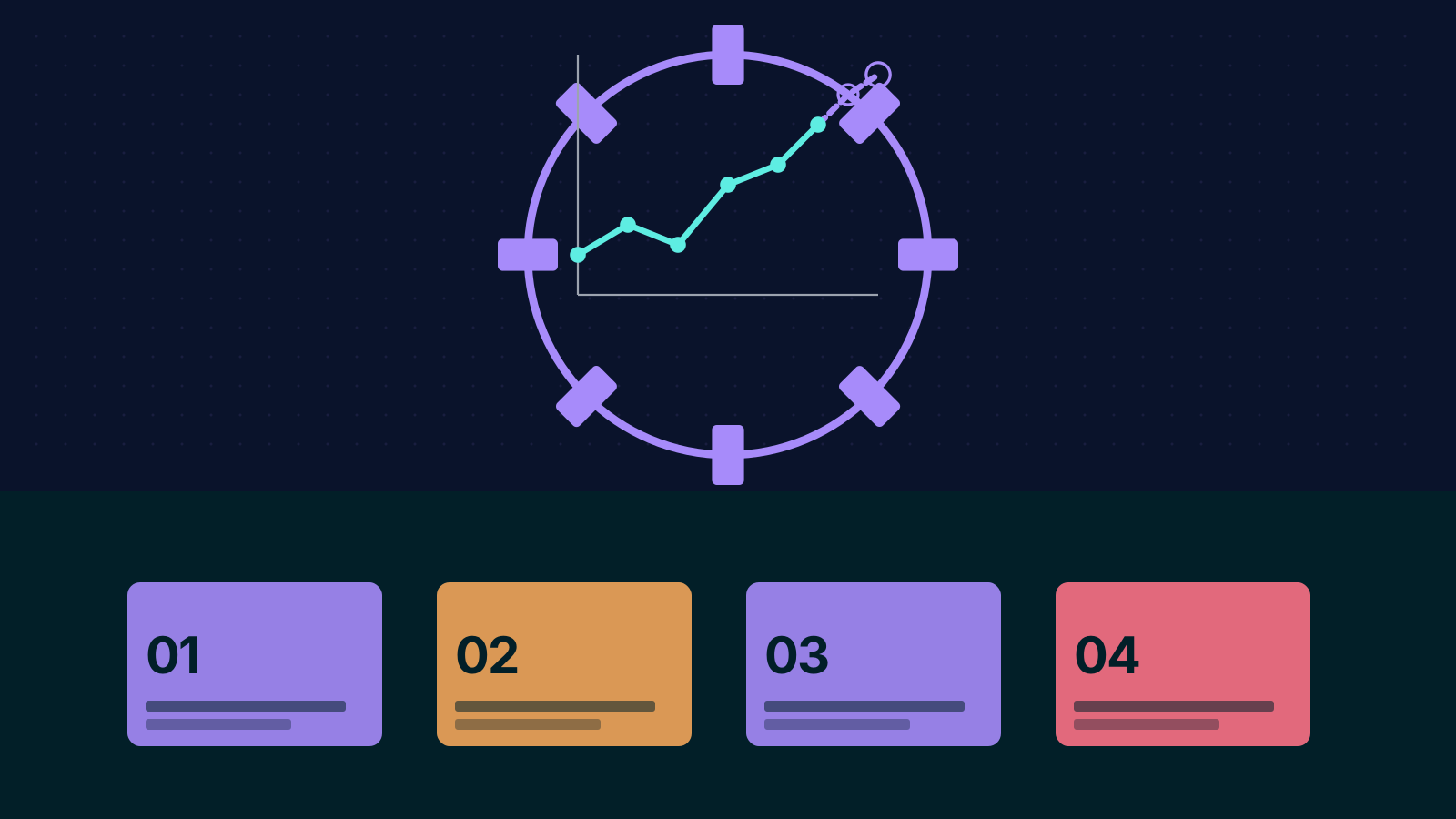
Marketing forecasting sounds straightforward in theory: use historical data to predict future outcomes. In practice, most first attempts at forecasting fail, not because the models are wrong, but because the inputs are incomplete, inconsistent, or misunderstood.
Before investing in forecasting tools or hiring a data scientist, you need to get the foundations right. The quality of any forecast is determined by the quality and completeness of the data feeding it. This guide covers the prerequisites that separate forecasts that inform decisions from forecasts that mislead them.
The Minimum Data You Need
A useful marketing forecast requires three categories of data: marketing inputs, business outcomes, and external factors.
Marketing inputs include channel-level spend, impression volume, click volume, and any campaign-level variables that changed over time such as audience targeting shifts or creative refreshes. These need to be captured at a consistent granularity, ideally weekly, over a sufficient time period.
Business outcomes are the metrics you want to forecast: revenue, conversions, leads, pipeline value, or whatever your primary KPI is. These must be attributable to the same time periods as your marketing inputs. If your spend data is weekly but your revenue data is monthly, the mismatch will degrade forecast accuracy.
External factors include seasonality patterns, promotional calendars, economic indicators, and competitive activity. These variables influence outcomes independently of marketing spend, and omitting them from the model means the forecast cannot distinguish between a spend-driven result and an external-driven result.
How Much Historical Data Is Enough
The common rule of thumb is two to three years of historical data. This is not arbitrary. You need enough data to capture at least two full cycles of seasonality so the model can separate recurring seasonal patterns from underlying trends.
If you have less than two years, forecasting is still possible but the results will be less reliable, particularly around seasonal periods the model has only seen once. In this case, supplementing with industry benchmarks or analogous data from similar businesses can partially compensate.
More data is not always better. Data from more than four or five years ago may reflect a different competitive landscape, different channel mix, or different business model. Including it can introduce noise rather than signal. The ideal window captures enough history to identify patterns while remaining representative of current conditions.
If your business has undergone significant changes, such as entering a new market, launching a new product line, or shifting channel strategy dramatically, the useful history may be shorter than the total available history. Marking these structural breaks in your data helps the model adapt rather than averaging across fundamentally different periods.
Data Quality Issues That Undermine Forecasts
The most common data quality issue is inconsistent tracking. If your analytics setup changed partway through the historical period, for example migrating from Universal Analytics to GA4, you will have a discontinuity in your outcome data that the model may misinterpret as a real change in performance.
Missing data is the second major issue. Gaps in spend data, periods where conversion tracking was broken, or months where a channel was paused without documentation all create holes that the model must either interpolate around or ignore. Documenting known data gaps before building the model prevents false conclusions.
The third issue is aggregation inconsistency. If some channels report gross spend while others report net spend, or if conversion definitions changed over time, the model is comparing numbers that are not actually comparable. Normalising definitions across the entire dataset is tedious but essential.
Finally, watch for survivorship bias. If you only have data from channels that are currently active, the model cannot account for the performance of channels you previously tested and stopped. This can lead to overestimating the potential of your current channel mix.
Choosing the Right Forecasting Approach
Not every business needs a sophisticated machine learning model. The right approach depends on the complexity of your marketing mix, the volume of data available, and the decisions the forecast needs to inform.
For businesses with a simple channel mix and consistent historical patterns, a time series approach like ARIMA or Prophet can produce reliable forecasts with relatively little setup. These models identify trends and seasonality in a single outcome variable and project them forward.
For businesses with a complex multi-channel mix that needs to model the relationship between spend and outcomes, regression-based approaches or media mix models are more appropriate. These models can answer not just what will happen but what will happen if we change our spend allocation, which is where predictive analytics delivers its highest value.
Start simple and add complexity only when the simpler model's limitations become a practical problem. A basic forecast that is directionally correct is more useful than a sophisticated model that no one understands or trusts.
Setting Realistic Expectations
No forecast is a prediction of the future. It is an estimate based on the assumption that the relationships observed in historical data will continue to hold. When they do, the forecast is useful. When they do not, because of a new competitor, a platform algorithm change, or an economic shift, the forecast will miss.
The most productive way to use a forecast is not as a single number but as a range. A forecast that says next quarter's revenue will be between eight hundred thousand and nine hundred and fifty thousand dollars with seventy percent confidence is more honest and more useful than one that says revenue will be eight hundred and seventy-five thousand dollars.
Build your forecasting practice with the expectation that you will be wrong sometimes. The goal is not perfection. The goal is to be directionally correct often enough that forecast-informed decisions consistently outperform gut-feel decisions. Even a modest improvement in decision quality, compounded over dozens of allocation and investment decisions per year, delivers significant value.
Ready to build forecasting into your marketing operations? Our forecasting solutions start with your existing data and build toward a model that supports confident budget decisions.