
How Predictive Analytics Differs from Traditional Reporting
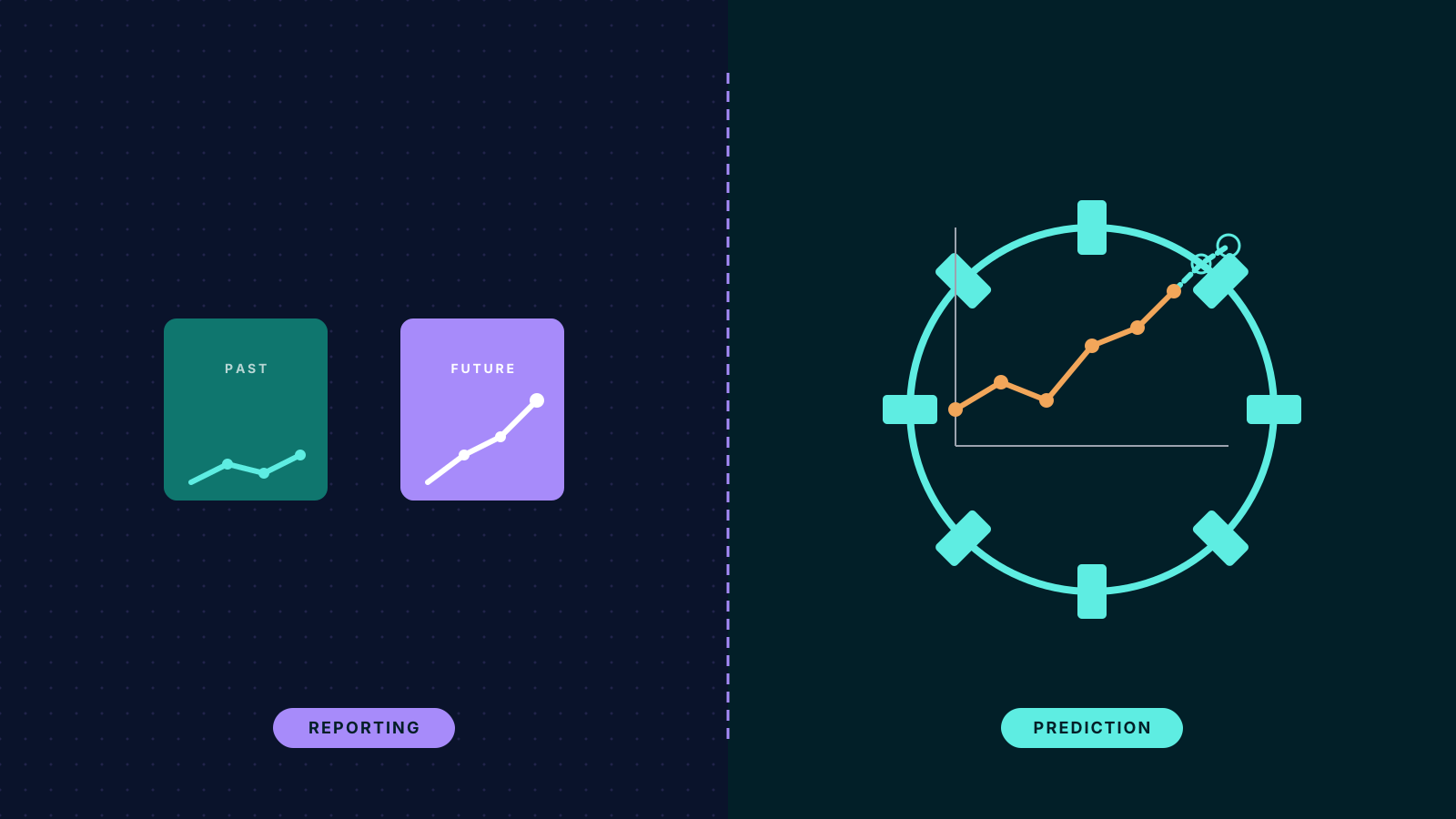
Most marketing teams rely on reporting to guide their decisions. They look at last month's performance, identify what went up and what went down, and adjust their plans accordingly. This backward-looking approach has obvious limitations: it tells you what happened but not what will happen, and by the time you act on the insight, the conditions that produced it may have already changed.
Predictive analytics flips this orientation. Instead of describing the past, it estimates the future. Instead of answering what happened, it answers what is likely to happen and what should we do about it. The difference is not just technical. It changes how marketing teams plan, allocate resources, and respond to changing conditions.
What Traditional Reporting Does Well
Traditional reporting is essential and should not be replaced by predictive analytics. It provides the foundation of accountability: how much did we spend, how many conversions did we generate, what was the cost per acquisition, and how did performance compare to target.
Good reporting answers descriptive questions clearly and accurately. It identifies trends, flags anomalies, and provides the historical context needed to evaluate current performance. Analytics reporting done well is the starting point for every data-informed decision.
Where reporting falls short is in its inability to answer forward-looking questions. It cannot tell you what will happen if you increase budget by twenty percent. It cannot estimate the impact of launching a new channel. It cannot model the trade-off between efficiency and volume at different spend levels.
What Predictive Analytics Adds
Predictive analytics builds mathematical models that capture the relationships between marketing inputs and business outcomes. These models use historical patterns to estimate future results under different scenarios.
The most immediately useful application is forecasting: projecting next month's or next quarter's performance based on planned spend levels and expected market conditions. A good forecast narrows the range of uncertainty around future outcomes and gives planning teams a data-informed basis for budget and resource decisions.
Scenario modelling extends forecasting by answering what-if questions. What if we increase spend by thirty percent? What if we shift budget from one channel to another? What if a competitor enters the market? These questions cannot be answered by looking at historical data alone. They require a model that understands the causal relationships between variables.
Propensity modelling identifies which customers or prospects are most likely to take a specific action: purchase, churn, upgrade, or respond to an offer. This enables more targeted marketing that concentrates resources on the audiences most likely to convert.
The Mindset Shift
The most significant difference between reporting and predictive analytics is not technical. It is the mindset shift from reactive to proactive decision-making.
A reporting-driven team waits for results, analyses them, and then adjusts. This cycle introduces a lag between when conditions change and when the team responds. In fast-moving markets, this lag means the team is always optimising for yesterday's conditions.
A predictive analytics-driven team anticipates results before they happen and adjusts proactively. If the model predicts that a channel is approaching saturation, budget is reallocated before efficiency declines. If the model predicts that seasonal demand is shifting earlier than usual, campaigns are adjusted ahead of the curve.
This proactive orientation does not replace the need for reporting. It layers on top of it. Reporting validates whether the predictions were accurate. Predictions inform what actions to take next. The two capabilities are complementary.
Getting Started Without a Data Science Team
Many marketing teams assume that predictive analytics requires a dedicated data science team and expensive tools. While advanced implementations benefit from specialist expertise, there are practical entry points for teams at any maturity level.
Start with simple regression analysis. A basic model that estimates the relationship between spend and conversions in a spreadsheet is already a predictive model. It is imperfect, but it is more useful than no model at all.
Use platform-provided predictions. Google Ads provides bid simulation data that estimates how bid changes will affect volume and cost. Meta provides estimated audience sizes and reach forecasts. These built-in tools are accessible without any statistical expertise.
Forecasting solutions and media mix modelling provide the structured framework for predictive analytics that most marketing teams need, without requiring them to build models from scratch.
The key is to start. A team that makes decisions based on a simple forecast consistently outperforms a team that makes decisions based on last month's report. The sophistication of the model matters less than the orientation toward forward-looking decisions.