
What a CRO Agency Does and Why Your Business Needs One
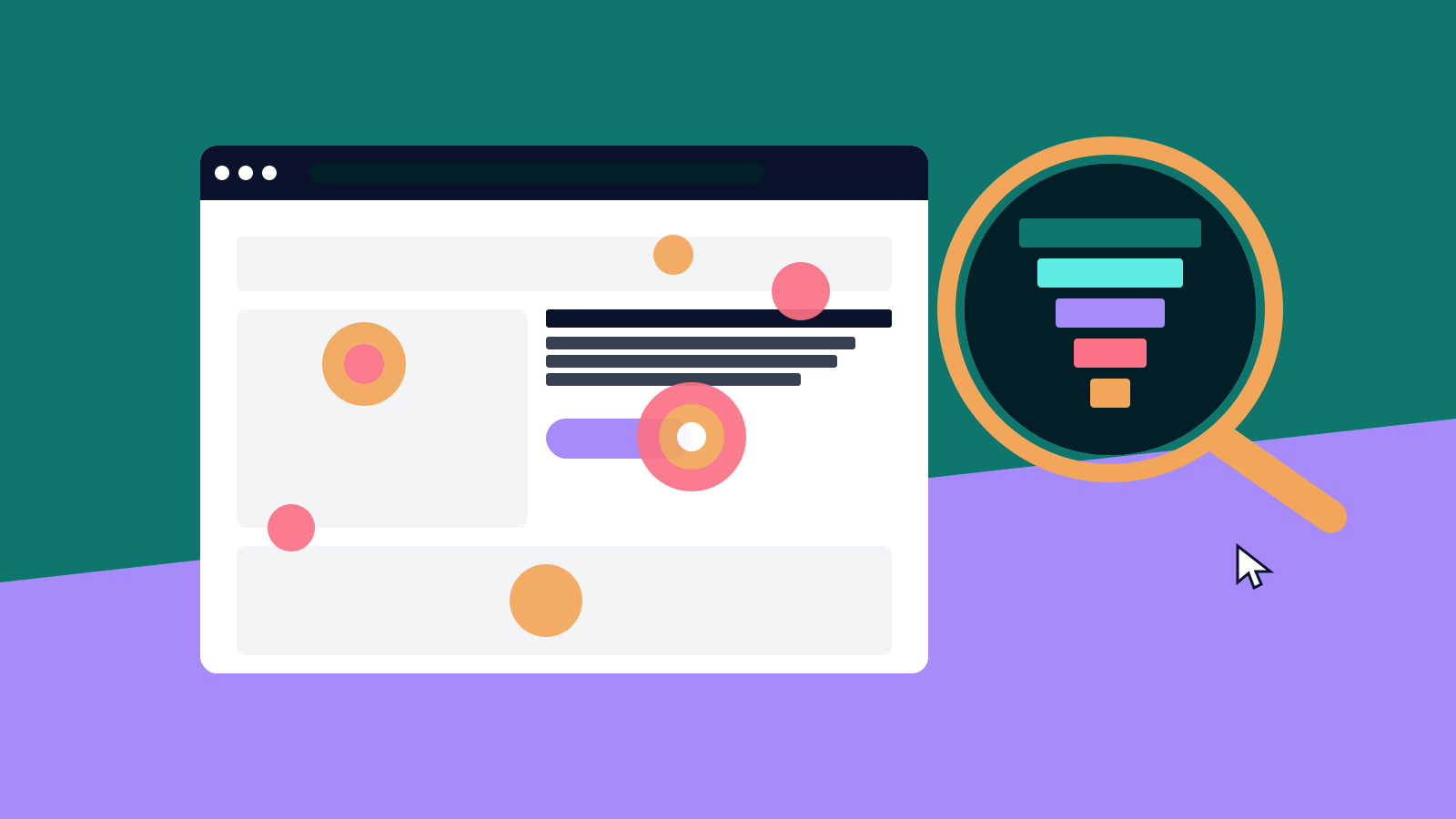
You are driving traffic to your website. Your paid search campaigns are running, your SEO is generating organic visits, and your social media advertising is building awareness. But here is the question most Australian businesses fail to ask: what happens after the click?
A conversion rate optimisation agency exists to answer that question systematically. CRO agencies specialise in understanding why website visitors do or do not take the actions you want them to take, and then methodically improving the experience to increase the percentage who convert.
If you are spending money to drive traffic but not investing in what happens when that traffic arrives, you are leaving revenue on the table. Here is a detailed look at what CRO agencies do and why this discipline is essential for any business serious about digital growth.
What CRO Actually Involves
Conversion rate optimisation is not about making your website prettier. It is a data-driven discipline that combines analytics, user research, psychology, and systematic testing to improve the percentage of visitors who complete a desired action.
That desired action varies by business. For ecommerce, it is typically a purchase. For B2B services, it might be a contact form submission, a demo request, or a phone call. For SaaS businesses, it could be a free trial signup or a pricing page visit. Whatever the action, a CRO agency's job is to increase the rate at which it happens.
The process involves three core activities. First, research and analysis to understand current performance and identify problems. Second, hypothesis development to propose specific, testable improvements. Third, experimentation to validate whether those improvements actually work.
This cycle repeats continuously. CRO is not a one-time audit or a website redesign. It is an ongoing program of measurement, learning, and improvement that compounds over time.
The Research Phase: Understanding Your Users
Before changing anything, a CRO agency invests heavily in understanding your current situation. This research phase typically includes a deep dive into your analytics data to identify where users drop off, which pages underperform, and which traffic sources produce the most engaged visitors.
Quantitative data tells you what is happening. Qualitative data tells you why. CRO agencies use a range of qualitative research methods including heatmaps that show where users click, scroll, and hover. Session recordings that replay individual user journeys. On-site surveys that capture visitor feedback in real time. And usability testing where real users attempt to complete tasks on your website while verbalising their thought process.
This combination of quantitative and qualitative research produces a rich picture of the user experience. Common findings include unclear value propositions that fail to communicate why a visitor should choose your business, friction in forms that causes users to abandon partway through, trust gaps where users hesitate because they lack confidence in your credibility, and navigation problems where users cannot find what they are looking for.
The research phase is what separates professional CRO from guesswork. Without understanding the specific problems your website has, any changes you make are shots in the dark.
Hypothesis Development and Prioritisation
From research findings, a CRO agency develops a backlog of hypotheses. Each hypothesis is a structured statement: we believe that making this specific change will improve this specific metric because our research shows this specific user problem.
Not all hypotheses are created equal. CRO agencies use prioritisation frameworks to rank hypotheses by their expected impact, the confidence level based on supporting evidence, and the effort required to test them. High-impact, high-confidence, low-effort tests run first.
This prioritisation is critical because testing resources are finite. Your website traffic determines how many tests you can run simultaneously and how quickly each test reaches statistical significance. A CRO agency allocates those resources to the tests most likely to produce meaningful results.
The best CRO agencies maintain a living backlog that evolves based on test results. Each completed test generates new insights that inform new hypotheses, creating a virtuous cycle of continuous learning and improvement.
Testing and Validation
The testing phase is where hypotheses meet reality. The most common testing method is A/B testing, where half of your traffic sees the original page and half sees a variant with the proposed change. The CRO agency monitors the results until the test reaches statistical significance, then implements the winning version.
Statistical rigour is non-negotiable. Running tests without proper sample size calculations, ending tests prematurely, or testing too many variables simultaneously all lead to false conclusions. CRO agencies bring the statistical expertise to avoid these pitfalls.
Beyond simple A/B tests, CRO agencies employ more advanced methodologies when appropriate. Multi-variate testing examines combinations of changes simultaneously. Bandit testing dynamically allocates traffic to winning variants. Personalisation tests serve different experiences to different user segments based on behaviour, demographics, or traffic source.
Each test produces either a winner, indicating the change should be implemented permanently, or a non-significant result, indicating the change does not reliably affect user behaviour. Both outcomes are valuable because they build your understanding of what influences your specific audience.
Why Your Business Needs a CRO Agency
The fundamental reason to invest in CRO is economic efficiency. Improving your conversion rate is almost always more cost-effective than driving additional traffic. If you double your conversion rate, you effectively halve your cost per acquisition across every traffic source.
Most businesses dramatically underinvest in CRO relative to traffic acquisition. A common split is 95% of the marketing budget on driving traffic and 5% or less on optimising what happens when that traffic arrives. This imbalance means businesses are paying full price to acquire visitors and then losing the majority of them to a suboptimal website experience.
A CRO agency also brings objectivity. Internal teams are often too close to their own website to see its problems. They know where everything is, so they do not experience the confusion a first-time visitor feels. CRO agencies approach your website with fresh eyes and the user research tools to validate what they observe.
The compound effect of sustained CRO work is substantial. Businesses that run continuous optimisation programs typically see conversion rate improvements of 20% to 50% over 12 months. For a business generating $1 million in annual online revenue, even a 20% improvement represents $200,000 in additional revenue with no increase in marketing spend.
CRO also makes every other marketing investment more effective. Better measurement of what converts feeds back into smarter media buying, more targeted content creation, and more effective lifecycle marketing campaigns.
Getting Started With CRO
If you have never invested in CRO, the starting point is an honest assessment of your current conversion performance. Review your Google Analytics 4 data to understand your conversion rates by channel, device, and landing page. Identify the pages with the highest traffic and lowest conversion rates, as these represent the biggest opportunities.
Look for the obvious friction points first. Are your forms longer than they need to be? Is your value proposition clear within five seconds of landing on your homepage? Do your calls to action stand out visually and communicate a clear benefit? Can users easily find what they are looking for on mobile?
A professional CRO agency will conduct a thorough audit as a starting point and present you with a prioritised roadmap of improvements. The best agencies can typically show measurable results within the first two to three months of engagement.
The cost of not investing in CRO is the revenue you leave on the table every day your website underperforms. Every visitor who leaves without converting is a missed opportunity that you have already paid to create.
Ready to convert more of your website visitors into customers? Get in touch to discuss how conversion rate optimisation can grow your business.